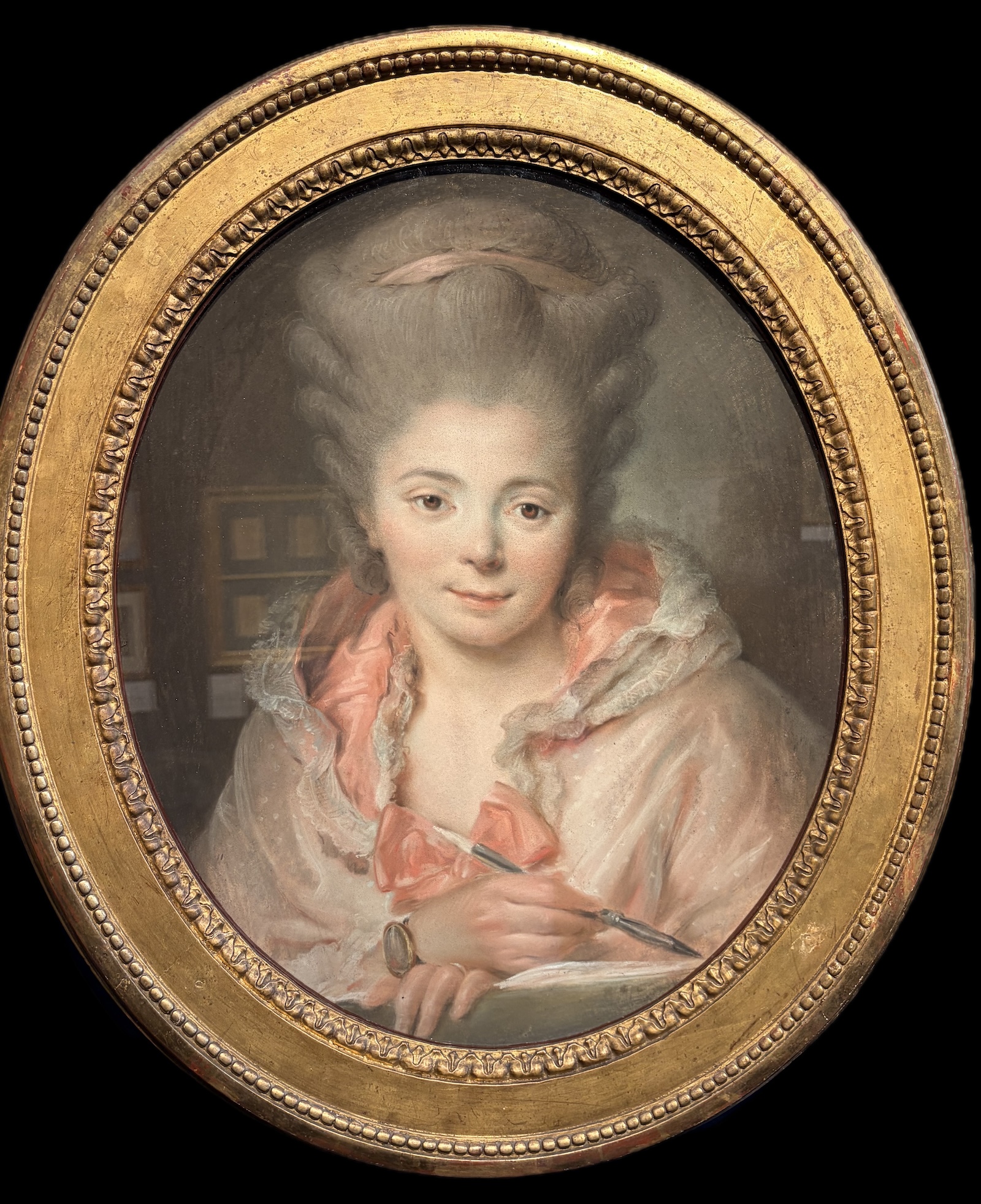
Female self-portraits, particularly in pastel, became a social phenomenon and a political manifesto in the last quarter of the 18th century, with more than 60 female self-portraits exhibited in the Salons between 1770 and 1804. Through them, women publicly claimed their true status as artists. No longer the object of the male gaze, they became the subject of their own, painting themselves as real individuals rather than mythical, historical or allegorical figures.
Several pastel artists pioneered this evolution, among them Marie-Suzanne Roslin, Adélaïde Labille-Guiard and Gabrielle Capet. The last was the daughter of a servant; when Capet exhibited a portrait of herself at work in 1784, she proved that art, particularly pastel, could be a powerful vehicle for social advancement for women.
In 1786, encouraged by the successes of these pioneering female artists, young students of the French School flocked to the Salon de la Jeunesse on Place Dauphine to exhibit their self-portraits. It is highly likely that this delicate pastel, which depicts a young woman confidently holding a pencil in her right hand as she draws, was created during these years by one of the most talented of these young artists. This surge of emancipation, especially visible through pastel painting, was unfortunately halted by revolutionary institutions such as the Société Populaire et Républicaine des Arts, which once again excluded women from the field of art from 1793 onwards.
In this charming, sensitive, and refined self-portrait, the artist reveals herself as much as she asserts herself. Beyond being a work of great quality, this portrait is a perfect illustration of the vogue for pastel in the 18th century and a brilliant testimony to the appeal of this medium for women at the end of the century.