Edmond Hoyois’ works – and the man himself – have long been shrouded in mystery. Born in 1882 in Las Couture, Pas-de-Calais, not much is known about his childhood or his introduction to art. Before embarking on a career as an artist, Hoyois fought in the First World War, mobilised in 1914 when he was 32 years old. His actions on the battlefield earned him the Croix de Guerre.
After the armistice, the decorated veteran moved to Paris, set up a studio near Montmartre and threw himself into his art. While a few records describe Hoyois as a painter and sculptor, his reputation rests on his pastels.
He exhibited regularly in Paris, taking a prize at the Salon des Artistes Anciens Combattants—the annual exhibition founded by his fellow veteran Lucien Roudier—and earning recognition at the 1925 Exposition des Arts Décoratifs. In 1929, the Salon des Humoristes displayed his pastel A beau chat… belle queue (A beautiful cat… a beautiful tail), in which a cat regards the artist with an unblinking stare. Hoyois’s command of pastel allowed him to render fur with remarkable finesse.
Hoyois also travelled beyond the French capital on occasion. This was the case in 1934 and 1937, when he set up his easel outdoors in Bourges. By this time, he had become known for his distinctive signature, with a journalist from La Dépêche du Berry spotlighting his cat portraiture. Rather than narrow his practice, this concentrated focus is precisely what gives the pastels their distinctive force, turning the familiar animal into a mirror of humanity.
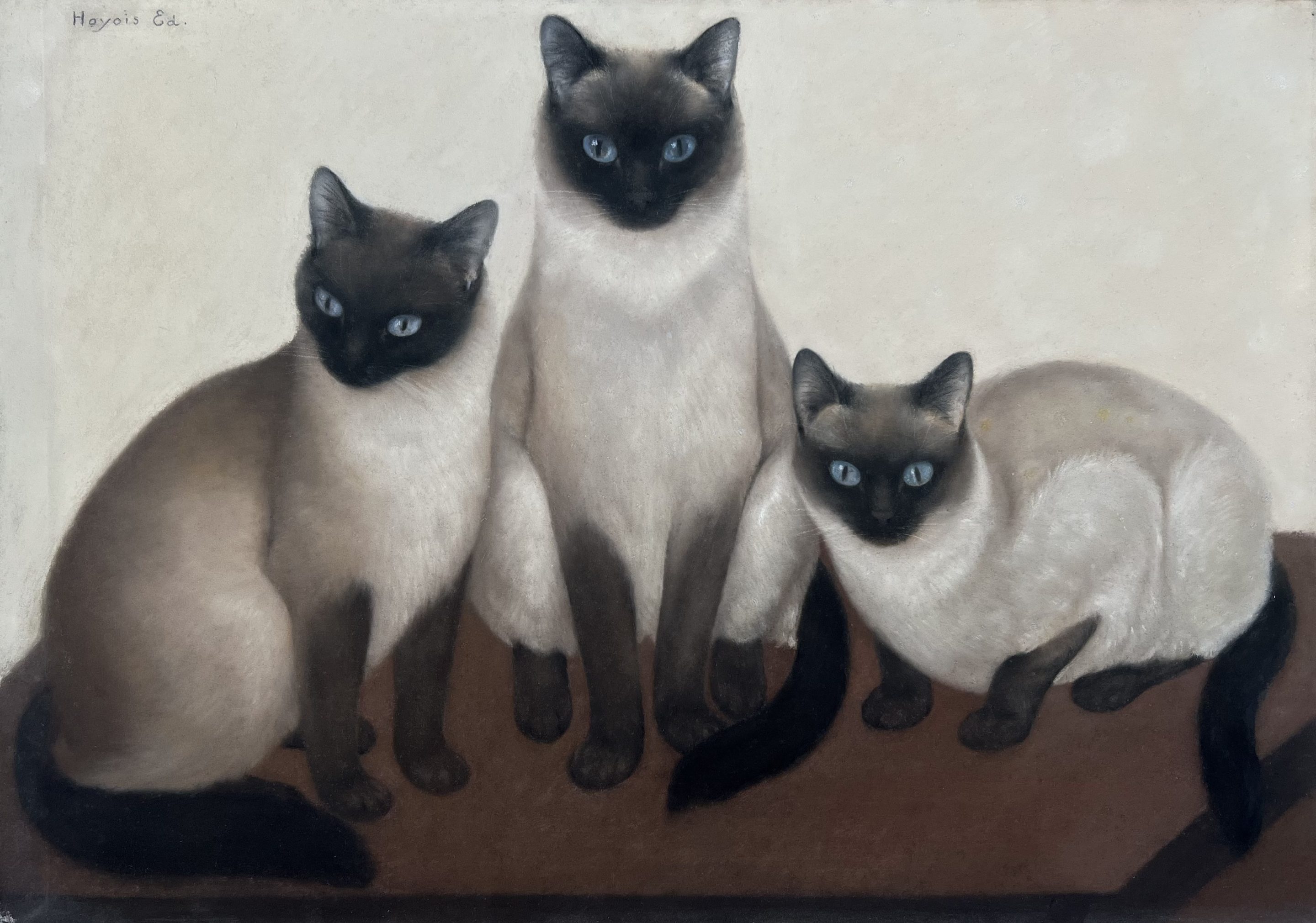
Whether Angoras, Chartreux, Siamese or ordinary street cats, his felines confront the viewer with a hypnotically ethereal intensity. This, combined with the often neutral background of his compositions, lend the animal a silent, almost meditative presence.
The pastel in EKCART Asia’s collection, painted in 1935, belongs to the small group of his works depicting more than one cat. It features three Siamese cats in a perfectly balanced triangular composition, their blue-grey eyes strikingly oriented towards the viewer.